
Language isn’t just a tool for communicating leadership; it’s the cognitive architecture through which we construct it.
The World Economic Forum’s 2026 theme, “A Spirit of Dialogue”, calls for a shift towards global cooperation. If dialogue is the catalyst for future progress, we must first dismantle the linguistic barriers and narratives that restrict it. Language isn’t just how we communicate leadership – it’s how we construct it. Our thoughts, identities, and actions as leaders are inseparably linked to the words we use.
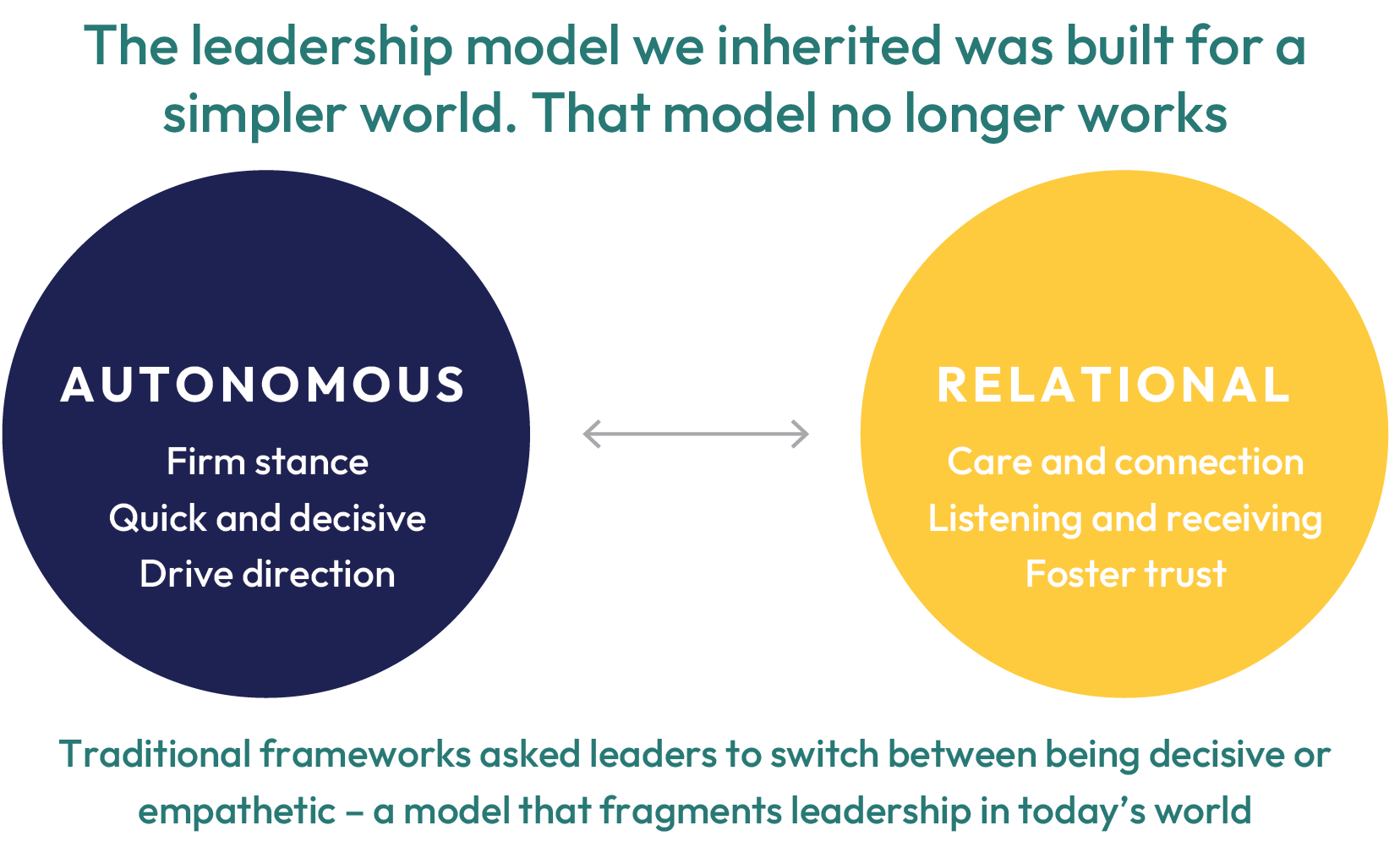
Yet, the language of leadership remains trapped in a simple, industrial past: driven by terms like “drives results” and “takes charge”, and steeped in the myth of the leader as a lone savior: certain, commanding, and self-reliant. This paradigm narrows the behavioral range of leaders and reduces leadership to a series of exhausting “either/or” trade-offs: people vs. performance, logic vs. intuition, strength vs. care. The result? A high energetic cost, chronic exhaustion, and systemic rigidity that over-indexes control while undervaluing “soft” relational capacities that sustain cooperation, genuine connection, and long-term resilience.
Leadership models once built on stability and hierarchy can no longer sustain themselves in a world marked by constant transformation, accelerating change, and complex interdependencies. — Global Future Council Report, 2026
Evolving our language is a lever for systems change.
Evolving our language is about rewiring the leadership mindset – an upgrade to our cognitive framework about what effective leadership looks like. Integration isn’t about compromise or finding a “softer” middle ground. It’s about moving from fragmented toggling - where leaders consistently switch between being “directive” or “collaborative” - to a coherent presence that holds both simultaneously. Integrated leaders don’t ask, “Which mode should I switch into now?” Instead, they ask, “What does this moment require - and how can I bring my full, integrated self to meet it?” This starts by replacing the binary ‘or’ with the integrated ‘and’.
By expanding our lexicon, we challenge deep-seated assumptions that have kept leaders small, reactive, and one-dimensional.
Integrated Thinking: Blending Intuition and Rationality
Leadership narratives often treat data-driven logic and intuition as opposing rivals – a “head vs. heart” binary – which forces leaders to choose between being rigorous and being human. Integrated thinking eliminates this trade-off by recognizing that “gut feelings” are a valid human intelligence to be used alongside empirical metrics. By treating intuition as “high-speed pattern recognition” and data as “systemic grounding,” leaders make decisions that are both grounded in hard metrics while simultaneously honoring invisible cultural weather.
From Fragmented: “The data says X, but my gut says Y.”
To Integrated: “My sense of the data and the system is...”
The Result: This shift activates both Rational and Intuitive capacities. Leaders make faster, higher-quality decisions in uncertain environments. They become better able to spot patterns in incomplete data, sensing when something isn’t adding up, and adjusting course early. Integrated thinking also helps communicate decisions in ways that resonate - grounded in evidence, without compromising how people are feeling.
Integrated thinking refers to simultaneously accessing and synergizing analytical reasoning and intuitive insight to make clear decisions that transcend both logic and intuition. This involves integrating many sources of data, insight, experience, and expertise, both subjective and objective.
Grounded Flexibility: Standing Firm and Staying Open
Industrial-era leadership has taught leaders that authority is synonymous with certainty. This creates “fragile power” that breaks when it encounters new information. Integrated Leaders move towards Grounded Flexibility by balancing assuredness and openness. They remain anchored in their own expertise and purpose whilst remaining open to the insights of others.
From Fragmented: “I have the answer.”
To Integrated: “I am clear on our goal, and I am open to how we might get there together.”
The Result: This shift activates both Powerful and Reflective capacities. Leaders become grounded in their “knowing” but flexible in their “doing”: stable under pressure, adaptable in complexity, and more trustworthy to those around them. The burden of success shifts from one heroic individual to a shared foundation of alignment and contribution.
Grounded flexibility refers to being grounded in one’s own knowing and understanding while remaining open to new insights and information to evolve one’s thinking.
A Lexicon of Integrated Capacities
By practicing these subtle shifts, we transform from a state of internal fragmentation towards a coherent, integrated presence capable of holding the complexity of modern systems.
Integrated Leadership is becoming the essential human infrastructure for complexity.
As global forums call for the next generation of sustainable leadership (Global Future Council Report, 2026), Integrated Leadership is emerging as the essential human infrastructure for navigating complex systems. Integration is not theoretical; it is measurable and trainable. Unlocking Eve utilizes the Integrated Leadership Diagnostic (ILD) to assess and build integration in leaders. To date, the ILD has been utilized by over 200 senior leaders and evaluators globally to guide the transformation towards effective, whole-system leadership.
Case Insight: Evidence from the Integrated Leadership Diagnostic
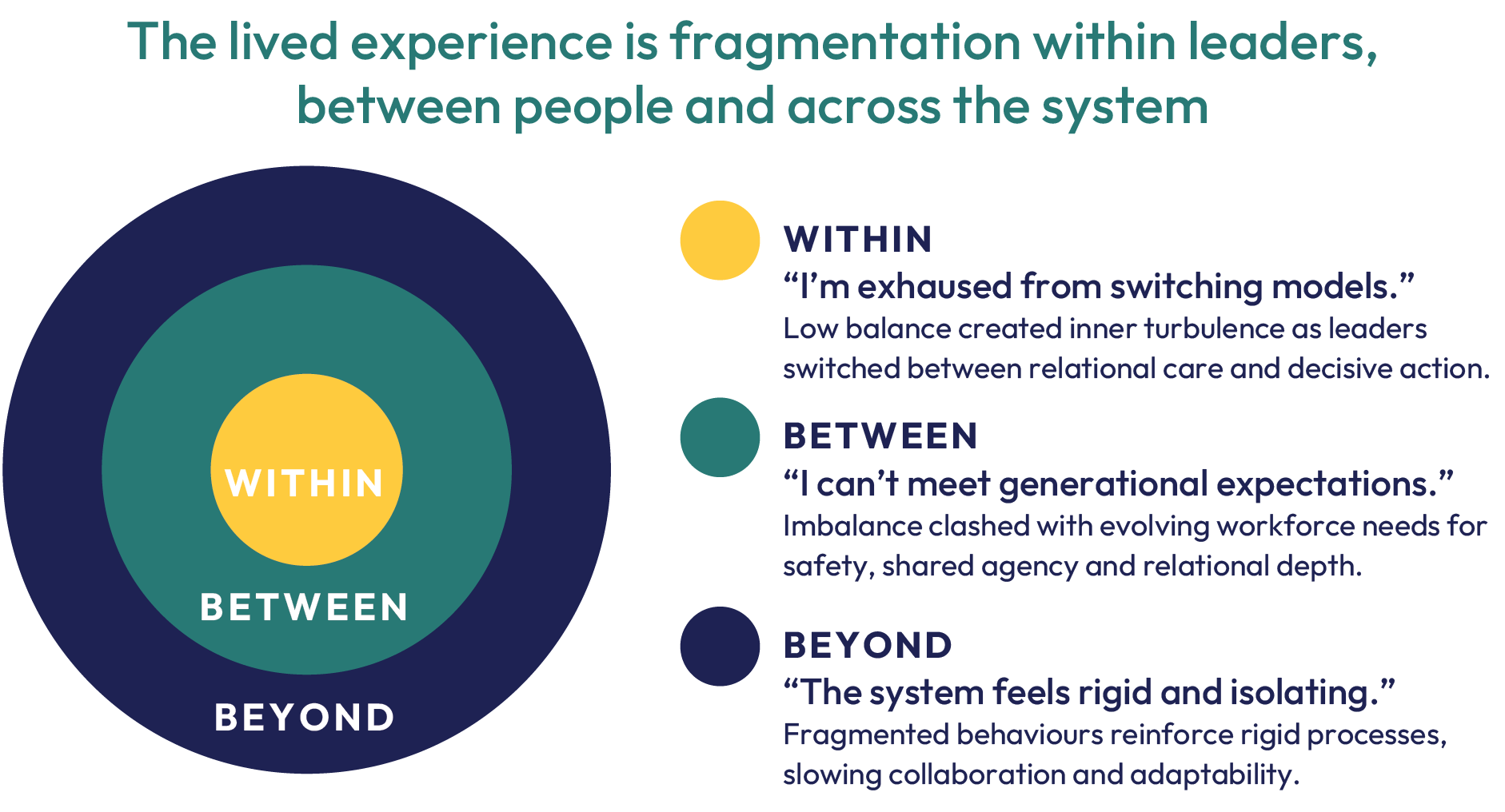
Our research on leaders shows a clear pattern of systemic failure when leadership systems over-rely on a narrow leadership range. In a cohort study of 45 CEOs, ILD data showed an over-reliance on Autonomous capacities (e.g., individualistic, rational, directive, powerful) while Relational capacities (e.g., communal, intuitive, reflective, empowering) were under-accessed. This imbalance manifested in three challenges that were felt within leaders, between teams, and beyond into the systems they lead:
1. Inner Exhaustion (emotional whiplash)
Leaders described a draining cycle of “mode-swinging” between empowering their teams and taking control. Because they view these as opposing binaries rather than integrated capacities, they experienced energetic toggling where leadership felt both exhausting and performative.
2. Intergenerational Friction
Leaders recognized they were trained in an era of autonomous output, but they’re now faced with generational values of empathy and safety. When empathy was treated as a separate “task”, rather than an integrated way of being, it caused disengagement, strain, and stress in their teams.
3. Systemic Isolation
The “lone savior” leadership myth creates a one-way flow of care. Leaders felt the need to carry the weight of the system alone. Without relational infrastructure, this isolation makes true cross-sector cooperation difficult, rigid, and inflexible.
The future of leadership is integrated.
The 2026 mandate for a new leadership language and narrative is clear. By expanding our language, we challenge deep-seated assumptions that have kept leaders small, reactive, and one-dimensional. However, to truly inspire a “Spirit of Dialogue” and break through the ceiling of modern complexity, we need to go deeper than changing our words. We need to translate thought into practice - and fundamentally rethink what effective leadership looks like.
At Unlocking Eve, our mission is to expand global systems leadership by bridging research with real-world application. We help leaders evolve to more integrated, human, and system-aware approaches. Through research, diagnostic tools, and development, we help leaders build the capacity to lead with both strength and empathy, autonomy and connection – for a healthier, sustainable future.


